All posts by Marianne Skov Jensen

survivors

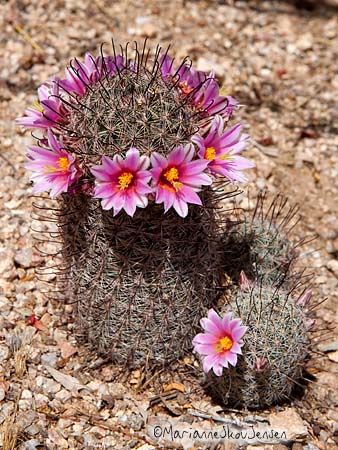
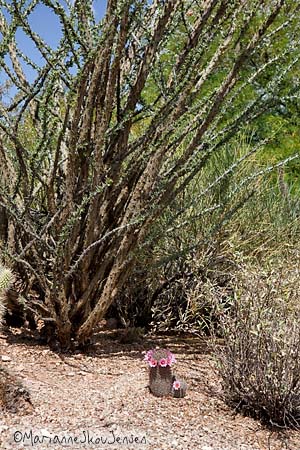
The Pincushion Cactus casualty I found in the driveway the other day had been growing behind the Ocotillo you see in the photo below. I’m amazed the Javelina missed the one you see in front of it because it’s out in the open. Pincushions (Mammillaria) typically grow under the protection of other cactus or shrubs so hungry Javelinas can’t reach them. I may end up having to rescue this one.
2009_06_01

Here’s a close up of this tiny precious survivor.
2009_06_01_2

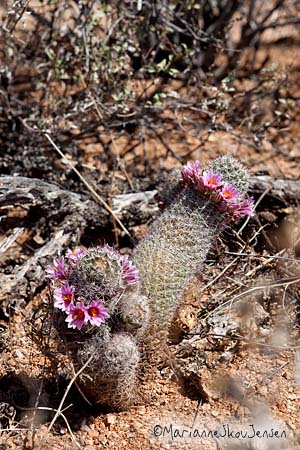
I then went for a walk in search of more blooms and within a quarter mile, found this one.
2009_06_01_3

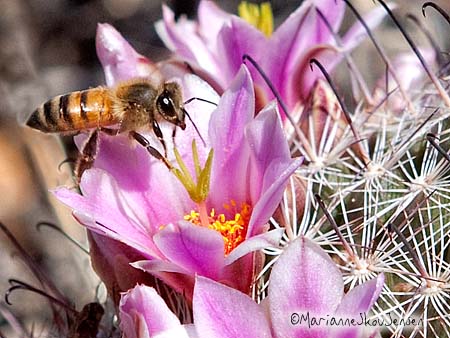
It was full of bees so it was difficult to leave 🙂
2009_06_01_4

javelina cafe closes its doors

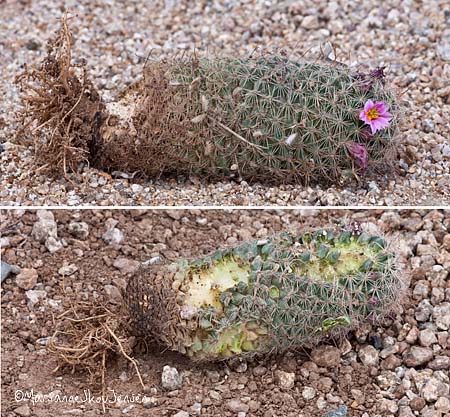
Found this latest victim of Javelina in the driveway yesterday.

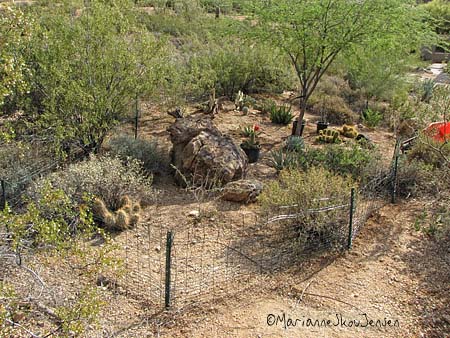
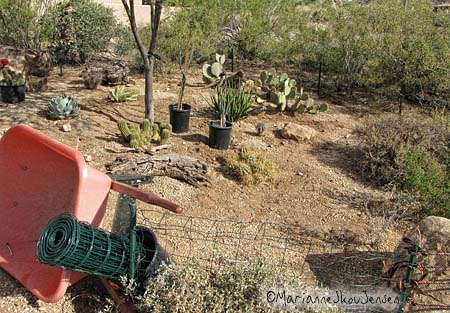
I’ve always said I didn’t want any fences on this property. I wanted to encourage wildlife, not discourage it. After all, they were here first and and the bonus was the photo ops! Well, after a few years of dealing with uprooted plants, new growth being chomped off and buds disappearing before they had a chance to bloom, I’ve decided that about 250 square feet will be off limits to Javelina. This is the area that has such great soil so I’ve been putting flowering cactus there. I can’t blame the Javelina for not being able to resist these plants! Most are not native to our area so they can’t control themselves when they get a whiff of the aroma of this juicy stuff. It’s like us trying to pass by an open door-ed bakery without stopping 🙂

2009_05_31

There’s nothing like doing a job yourself to gain new respect for people who do it for a living. For instance, I couldn’t just unroll the fence and attach it. I wish! Because of the elevation changes, I had to cut sections and attached each to the posts so it took me two days to finish. The fence isn’t very attractive but the shrubs will grow making it well disguised. In the meantime, I’ll add some big boulders at some of the more open areas because the fact is that unless it’s a concrete wall, the most I can hope for is that the fence and boulders will discourage the Javelina. If they’re really hungry, my little fence won’t stop them 🙂

2009_05_31_2

I’m looking forward to planting a Queen of the Night and several other cuttings that now might have a chance to grow. Time will tell!

helping thirsty trees

This past week, I implemented another technique I learned in landscaping school. It’s a way to direct water from a drip line straight down to the roots of a tree. This Sweet Acacia has struggled since I planted it two years ago so it was high time to help it out. This technique will also solve the problem of the other plants getting too much water.
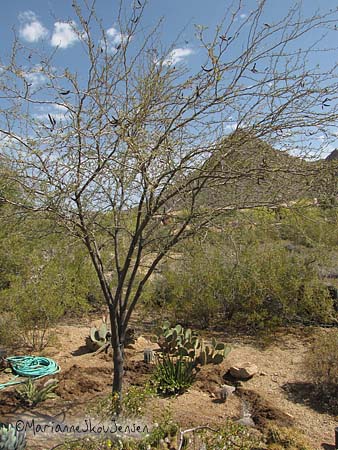
2009_05_30

I started by digging 9 holes about 1 foot deep and let the water run for a few hours.
I could almost hear the tree roots sighing with relief as they were slurping up the water 🙂
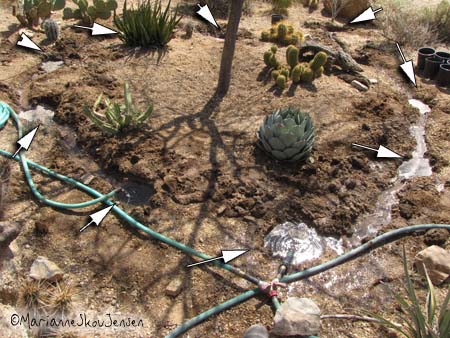
2009_05_30_2

Then I gathered up nine 1 gallon pots (save everything!) and cut off the bottoms.
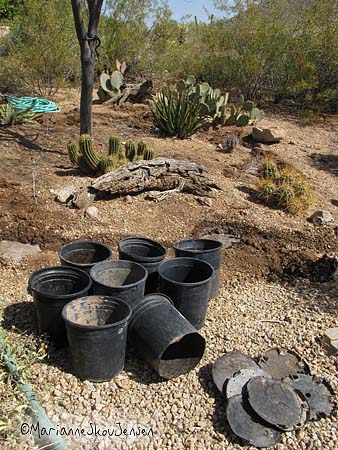
2009_05_30_3

Next I positioned the pots in the holes so the tops were just above ground level and held them in place while filling with small rocks. This let the rocks fall deeper so the pots were then sitting on the rocks.
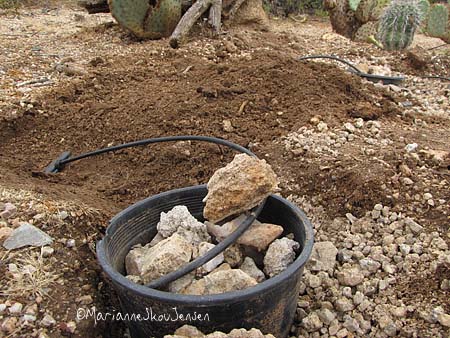
2009_05_30_4

The last step is to put a drip line into each pot and then cover them with decomposed granite.
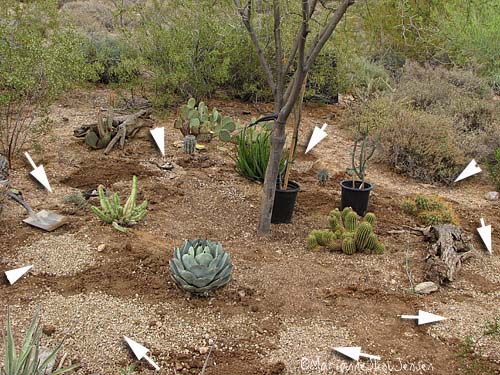
2009_05_30_5

I should add that I put in about twice as many holes than were needed but this was to give the tree a boost. As it recovers, I will plug up about half of the drip lines.

By the way, this area has the best soil on the property so my plan is to continue to plant flowering cactus and succulents there. I call it my Macro garden. Unfortunately, it’s also known as Javelina Cafe 🙂

Next on the agenda? Fencing.
anticipation

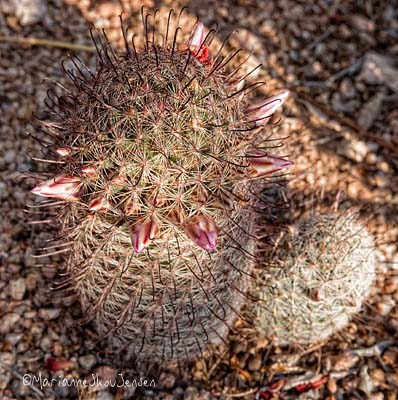
I noticed a full ring of flower buds of this Mammillaria grahamii list night so I got a shot early this morning. In fact, I see more than one ring so we might be in for a spectacular showing! Mammillaria, aka Pincushion Cactus, bloom a couple of times a year so if you miss the Spring showing, look for them in early fall. Actually, I’ve seen them at all times so just keep an eye out if you know where some are!

Mammillaria close to blooming

christmas blooms

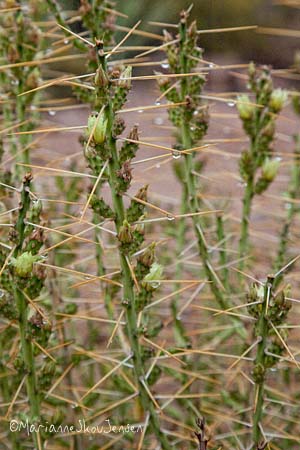
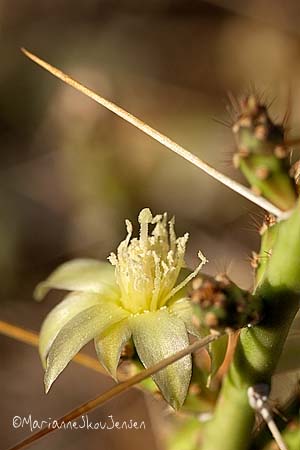
Christmas Cholla blooms (Opuntia leptocaulis) are a rare treat to see when hiking in the Preserve because they typically only appear very late in the day. Even if you did happen across one at the right time, you might not notice them because the blooms are very small. I’m lucky to have a few Christmas Cholla in my yard and because I watch my plants like a hawk, I noticed buds on one last week.

Christmas Cholla flower buds

I checked every afternoon and was rewarded last night. I grabbed my SLR and a 180mm macro lens and started shooting. I wanted to use the SLR in order to get very shallow depth of field (fuzzy backgrounds) which is difficult (if not impossible) to get with a compact camera. Anyway, it’s been awhile since I’ve used my big camera so I’d forgotten how heavy it can be. After a few blurry pictures from camera movement, I upped my ISO to get a faster shutter speed but ultimately went for my tripod 🙂

Opuntia leptocaulis at sunset

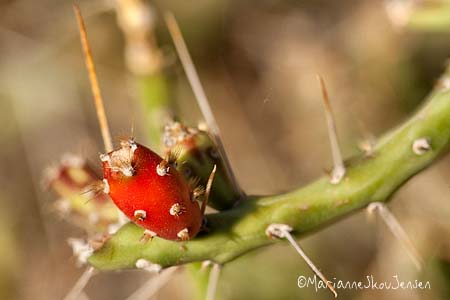
leftover fruit on the same Christmas Cholla

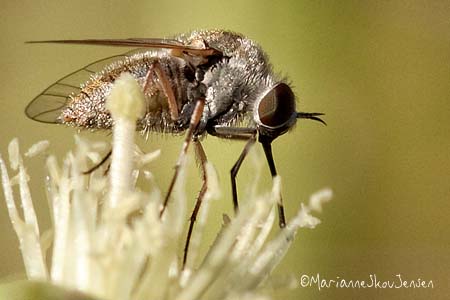
Flower Fly. What is it about bug eyes! I can't get enough :-)
Flower Fly. What is it about bug eyes! I can't get enough 🙂

displaced….almost

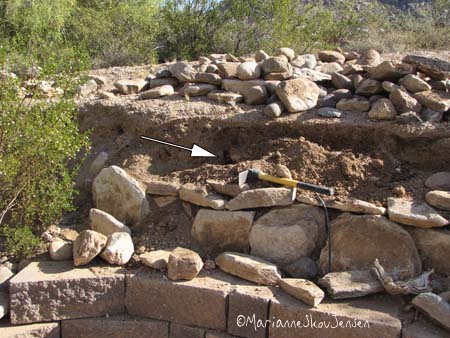
Besides unearthing various bugs while working on the rock wall, I almost destroyed a little homestead yesterday.
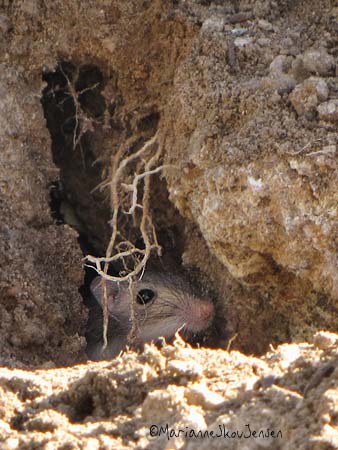
When I saw the tiny cave, I grabbed my camera, zoomed in and waited with high hopes that something would come out to investigate!
2009_05_26

The cute little guy below appeared for only a few seconds so it’s a good thing I was zoomed in and ready to shoot. It’s difficult to say for sure what it is but it appears to be a mouse of some kind. Anyway, I did have plans to cut into the bank a little farther but didn’t want to be responsible for displacing a family 🙂
2009_05_26_2
Update: It is more than likely a ground squirrel.

death-feigning beetle

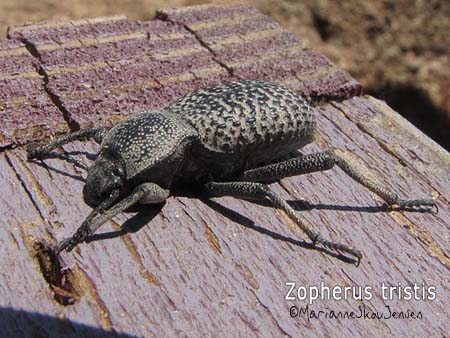
I found this awesome looking creature yesterday afternoon while reworking a rock wall and thanks again to an expert at Bugguide, I’m becoming educated regarding our local insects. I was most concerned with whether it wants to eat my plants/trees but I was assured that it doesn’t eat living plant tissue. So…keep your garden healthy!

Click on the photo to see my post for ID request at Bugguide.

Death-Feigning Beetle (Cryptoglossa)

Update: correct ID of this beetle is Cryptoglossa (Death-feigning Beetle)

being prepared

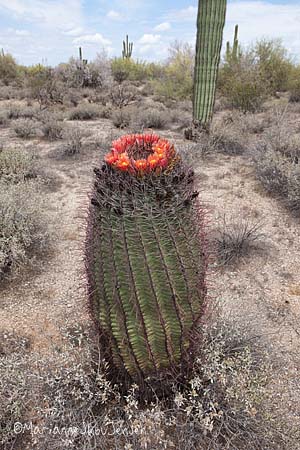
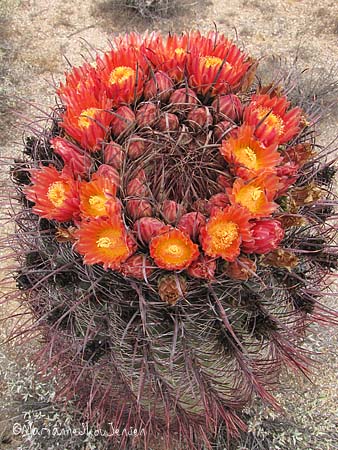
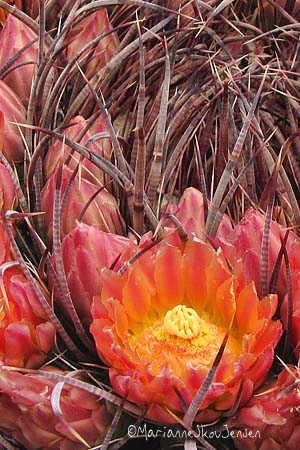
I always have a camera with me, (as you probably know), even if I don’t have shooting in mind because you never know when a photo op is going to present itself. Such was the case yesterday when I was on my way back from Home Depot (bought Javelina fencing….more later) and saw this huge Barrel Cactus out of the corner of my eye. It was overcast so the color of the blooms was unbelievably vivid! Thankfully the road I was on has very little traffic, because I literally slammed on my brakes. After I got over the vision of a rear end collision, I pulled over to the side of the road, walked through barbed wire fence and fought off rattlesnakes (not really) to get these photos.
2009_05_24_3
2009_05_24_2
2009_05_24

glochids

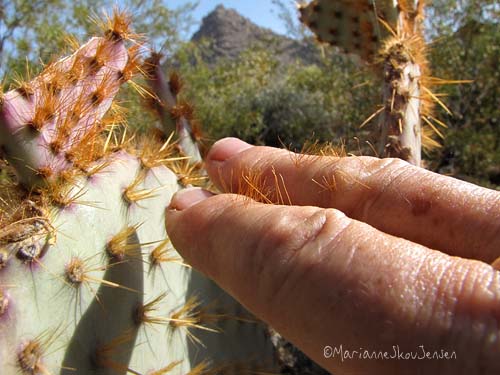
If you live near cactus, especially Cholla and Prickly Pear cactus, sooner or later you’re bound to have an encounter with Glochids. Generally, they’re not as painful as spines but unlike spines which you can easily grab and pull out (ouch!), Glochids are tiny and hair-like. Many can be microscopic in size so invariably, you never get them all. Worse is that sometimes they break leaving a little bit under your skin. The irritation can last for weeks and if you’re sensitive, it can end up being quite painful.

I was shoveling a little too close to this Prickly Pear and brushed my hand as I drew back.

Removing glochids:
1. Cover with duct tape and peel off. (I’ve tried this but never again. Although it does remove some of the Glochids, it can hurt as you apply the tape over them and many break off leaving parts under the skin).

2. Use Elmers glue; let it dry an then peel it off. (I loved this idea so I tried it. Have you ever waited for Elmers glue to dry out completely on your skin? You think it’s dry but it never dried completely for me so it was ultimately a waste of time.)

3. Tweezers and a good strong light source. (This is my personal choice. Specifically, I use the thin tweezers that are inside my Swiss Army knife).