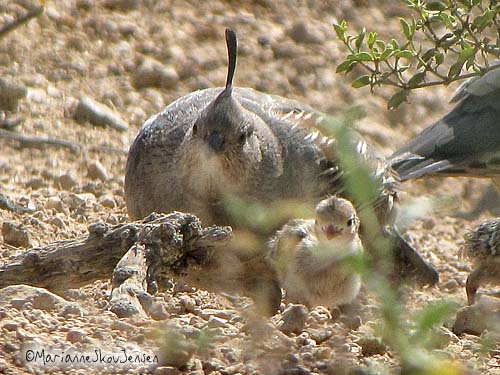
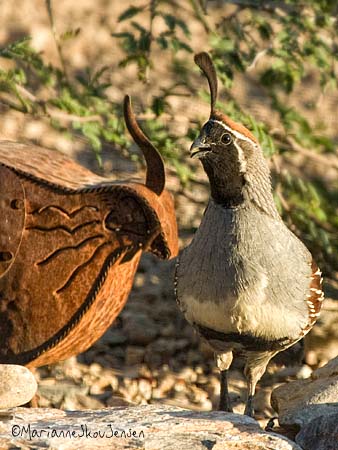
Gambel Quail families have been showing up lately and I’ve been trying all week to get a decent shot but the parents keep those babies moving so fast that it’s a challenge! The best luck I have is from my dining room window. The house sits low so I’m looking out at a the top of a bank. When I come in for a break, I always check the window for birds and when I saw them, I grabbed my trusty little Canon compact, zoomed in and was lucky to get this sweet shot 🙂
Cloudy days are a perfect time to create abstract photos by using intentional camera movement. This is a hit or miss process and you end up with LOTS of misses, believe me. But if you like the look, this type of photography is so much fun. The process is pretty easy and perfect for a compact camera (aka point and shoot) You might even end up giggling as I did when I first tried it 🙂
Here’s how: If it’s a bright cloudy day, wait until late in the day or until the light is really low. Then you need to manually adjust some settings on your camera. First set the ISO to the lowest number which in my case is 80 and then set the Aperture to the highest number which is f/8 on most small cameras. A high ISO and the smallest aperture (like F/8) will force the camera to choose a very slow shutter speed which you probably know will cause blurry photos. (If your camera is set to Automatic, it will try its best to make the photo sharp).
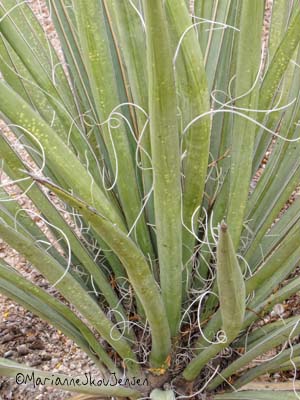
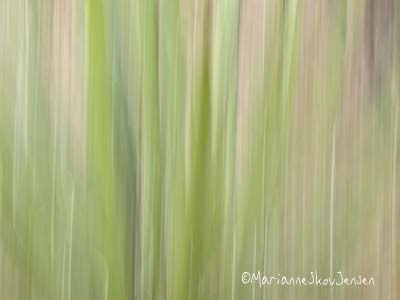
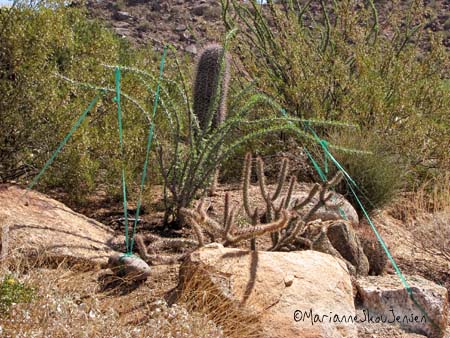
Here’s an example. First is the subject before moving the camera. Holding the camera steady - a boring image Using camera movement method
In order to make the blurring more creative looking, press the shutter WHILE moving the camera. As I mentioned, you get a lot more misses than hits but here are some tips to increasing your success rate.
1. Pre-visualize how you want the blur to look. For instance, for vertical blurs, move your camera up and down. For curves, move it in half circle movements. Shaking your camera in place creates a splotchy kind of effect which is nice for flowers.
2. Practice moving the camera slowly up and down (or which ever way you want) before you take your photo. When you’re ready, start moving the camera and without stopping, press the shutter at a random point of your movement. Viewing the resulting image on the LCD screen helps you decide at which point in the movement to press the shutter. Turning on “continuous” shooting will allow you to keep pressing the shutter while you continue to move the camera in all directions.
3. Use the Zoom of your camera to isolate what you want to capture. There’s a bonus to zooming. If your shutter speed isn’t slow enough, zooming in will reduce the amount of light reaching the sensor. Low light equals slow shutter speed equals blurry photos.
4. Take LOTS of photos! This is the key to getting something you like.
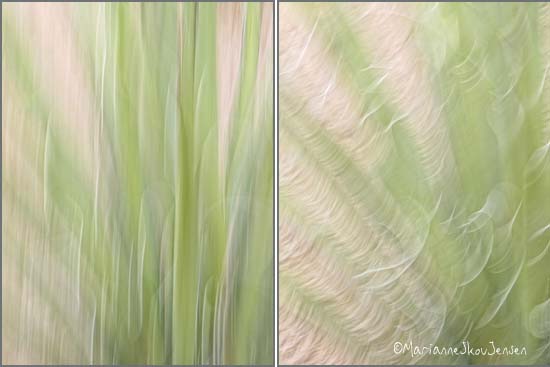
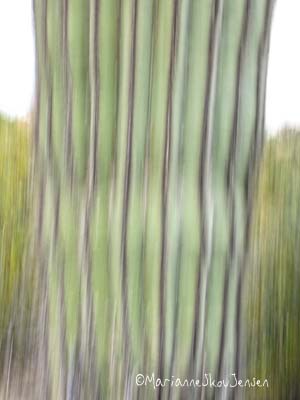
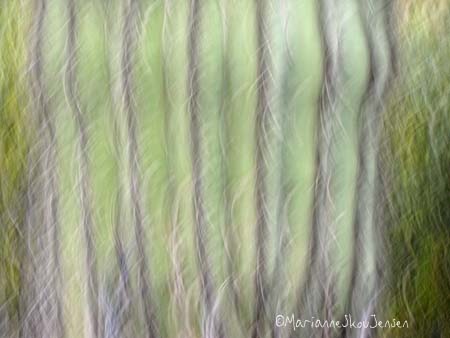
Here are some others I took this week. This is just the ground. Some of the streaks are decomposed granite. Saguaro cactus and Creosote bushes I first zoomed in on Saguaro detail. This is my favorite.
Finally….Night photography is especially fun using this method. You can also do it even if you can barely hold a camera. In fact, I’m so inspired by Alan Babbitt; a photographer with Parkinson’s disease. He discovered this fun way of shooting because he couldn’t hold his camera still and found he loved it. CLICK HERE so see his amazing images.
This week, I’ve been redirecting things. I’ll start with this recently purchased Ocotillo. I couldn’t resist it because it was actively growing in a pot which meant a higher likelihood that it would survive. See the green plant tape? It’s my attempt at coaxing the stalks to relax from vertical to a more natural position. Not very professional looking, I know 🙂
If you’ve ever bought an Ocotillo, you know the stalks are typically tied tightly together with wire and have probably been tied for some time. With dry bare root stalks, it can take a long time before they start to relax. However, in the case of this actively growing specimen with green stalks, I think my Bonsai-esque technique might just work to redirect them!
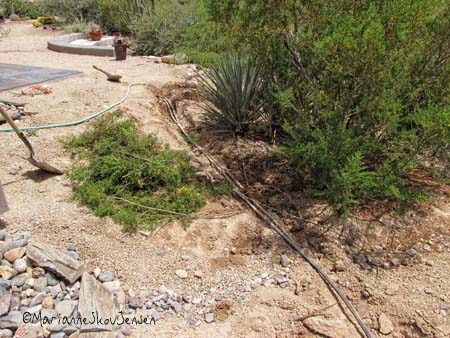
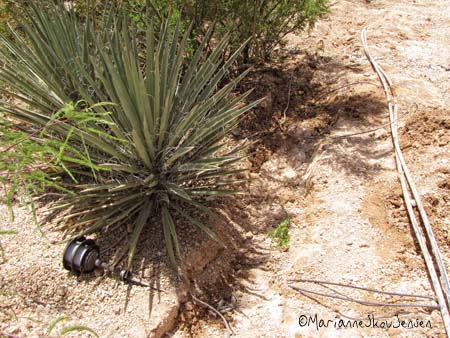
Another redirection job this week has been of water lines. Many had been put right next to plants and trees which has caused roots to wrap around them. Not good. By far, the most valuable thing I learned in Desert Landscape School was that you should move the water source out from a tree as needed to keep it just under the canopy edge. If you’re using spaghetti lines, all you need to do is just shorten it as needed. If water is only getting to the root ball, roots have no need to venture out so it’s probably not going to grow in a healthy manner. This explained why a couple of my trees have grown very little in two years.
Digging was not fun! Soaking the ground first really helps.
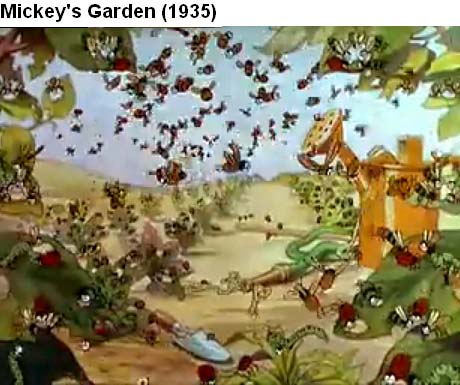
As I mentioned in yesterday’s post, I have Walt Disney to thank for my perceptions of all living things. Anthropomorphism is what I’m inflicted with. Click the word to find out how far back in history this goes!
With that in mind, who among you doesn’t think the following looks like a conversation 🙂 Wow....how do you get it to curve like that? Gel?
I’m taking a day off so today I’m sharing a wonderful cartoon called Mickey’s Garden.
I grew up on these cartoons which explains why I see faces on everything in Nature!
Thanks, Walt Disney 🙂
The first time I saw a Leafcutter Bee working, I was so mesmerized, I watched it for almost an hour. I’ve tried to get a photo of one carrying its prize piece of leaf but haven’t been successful yet.
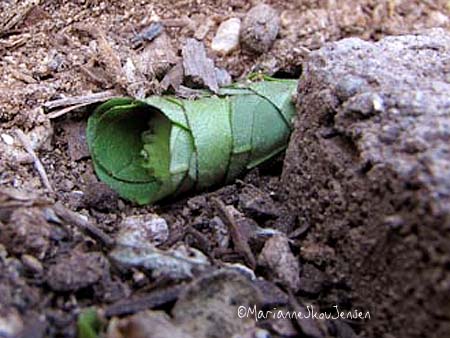
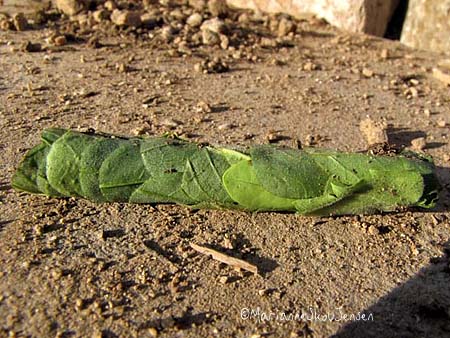
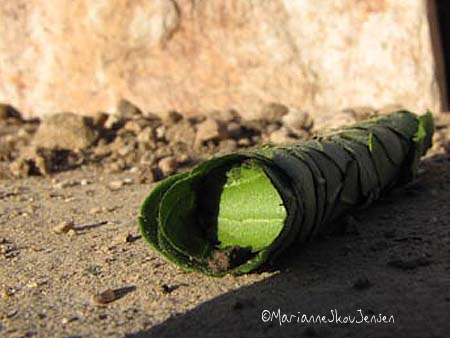
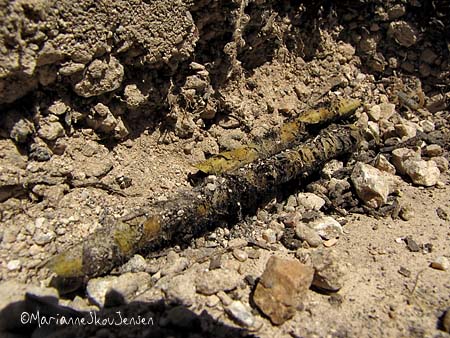
I had learned about the importance of our native bees (called Solitary Bees) during a class at Desert Landscaping School so I was very happy to see them in the yard and have come to love them. So last month when I uncovered a nest while reworking a block wall, I felt so guilty! Below are photos of the cigar-like nest. I tried my best to relocate it.
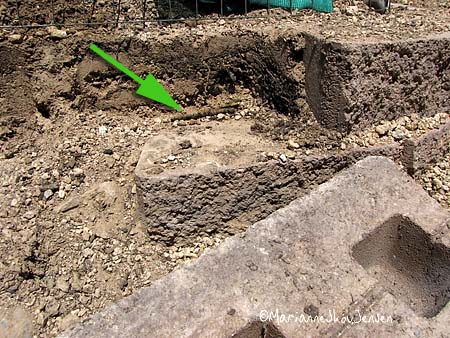
The bee dug in through an opening between the blocks. Can you believe the construction?! The nest is a series of chambers that are sealed off from each other. So cool!
Yesterday morning, I uncovered two more nests! According to the article in the above link, it could be that the larva have already matured and left. I really hope they have but just in case, I relocated them too.
Two more nests!
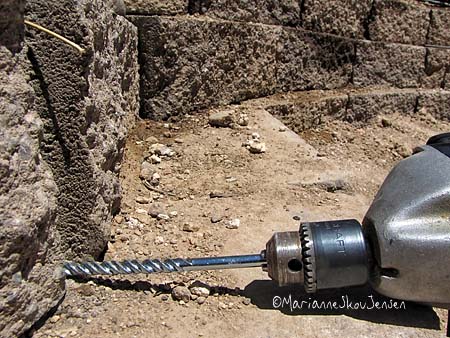
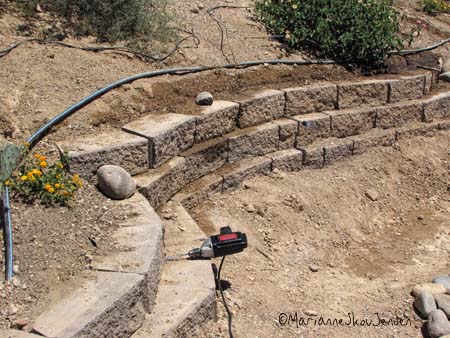
I want the bees to come back so I thought about making a wood nesting block but then I had an epiphany! Since the bees have been using the block wall, why not make the whole thing a nesting site. So I got my trusty drill, a masonry bit and drilled between the blocks to make sure the opening would accommodate a little bee body 🙂
I love power tools!Solitary Bee housing
I know what you’re thinking….is she NUTS?! Encouraging bees so close to the house!
Yes…I’m nuts but that’s beside the point 🙂
Solitary bees have a much different behavior than honey bees. Read this: Solitary Bees
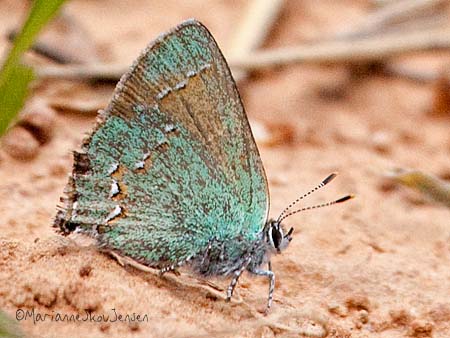
As promised, here are more photos from Saturday’s hike in Payson. In the first photo below, look for an arrow that shows just how tiny most of the butterflies were. The outing was a real treasure hunt! If I hadn’t been with people who knew what to look for, I’m sure I would have passed right by these little guys. Above photo has arrow indicating the size of the tiny butterfly
The next photo is a close-up of what we saw.
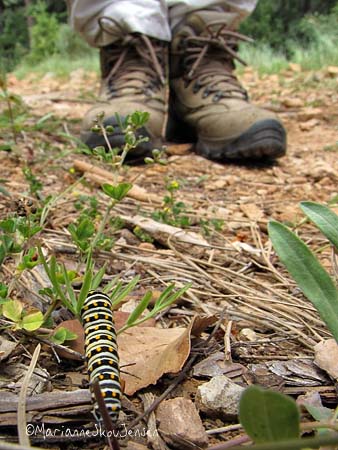
It was a treat to see the following caterpillar. After scouring my books and the internet, I’m guessing this is a Black Swallowtail Caterpillar. I also deduced this because we saw them on the trail. I included the only shot I got.
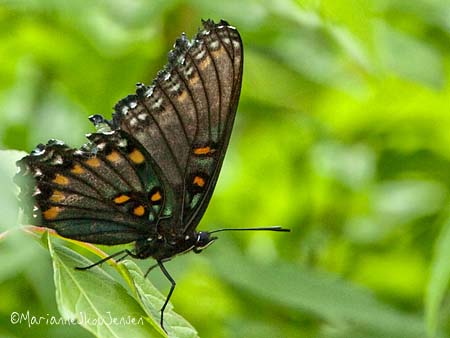
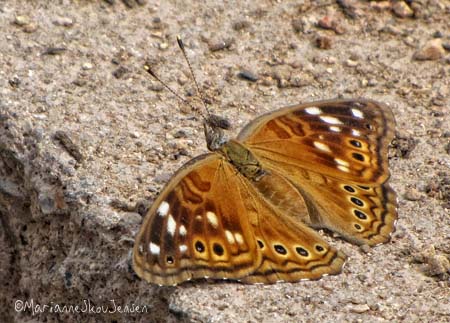
Update re this black butterfly. It is a Red Spotted Admiral also called Red Spotted Purple. As for the caterpillar, I still think it’s Black Swallowtail.
Click below to go to a slideshow of my best butterfly shots. The wind made getting sharp images a challenge so it was exciting to capture what I did. I also included a few shots of some bugs and flowers. Click on the the large photos to go to the next in line. The caption identifies them. I welcome corrections!
Update: corrections have been made. Thanks Janet! 🙂
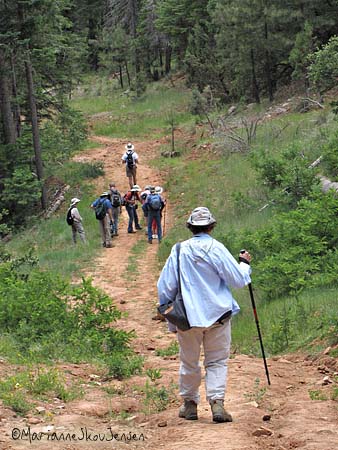
If you remember how excited I got when I found out about Rackensack Canyon, you have a feeling for how great I thought yesterday’s hike was! We went on the Colonel Devlin Trail starting at Washington Park Trailhead outside of Payson. TONS of flowers I’ve never seen. Most were just starting to bloom so there’s still plenty of time to photograph them. You’re following a stream much of the way which is thick with yellow Columbine on the banks right now. I hope to go back before they’re gone. For a photographer, I would call this an all day trip.
We ended up finding 26 varieties of butterflies. The wind made it difficult to get sharp photos of them all but I do have quite a few. I hope to create a slideshow this afternoon for Monday’s post. In the meantime, here are a couple of photos.
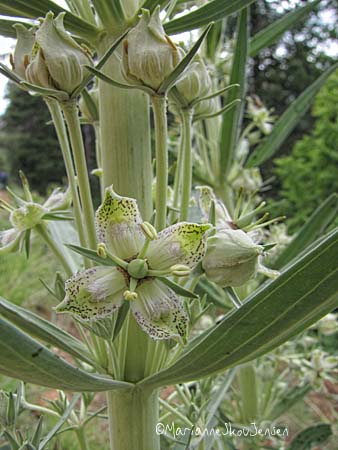
The trail is steep in places but not difficult if you go slowly This was the coolest plant we saw. Stalks about 3 feet tall.
I’m going to Payson with the Central Arizona Butterfly Assn today on a hike I’ve been looking forward to for months. It’s being led by two women well known in their fields of Lepidoptery and Botany so I’m bound to learn something! I joined the CAB in order to become familiar with the Butterflies I’m seeing in the yard but as it turns out, I was pleasantly surprised to find this group is really fun to photograph with. Not only am I learning during these outings but they stop a lot to document and discuss the species they see, as well as photograph them, so I have more than enough time to take ALL the photos I want. Click on the link at the beginning of this post to read about our destination. Then navigate to the Photos section to see some beautiful photos of Butterflies. There are some talented photographers in this group!
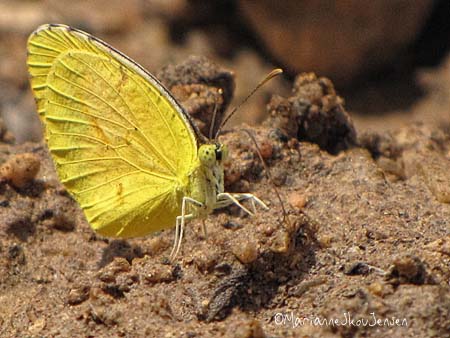
Here are two beauties I saw in my yard this week. Don’t know what they are (yet).
(Canon SX10 IS)
I have high hopes for photos of butterflies and flowers. Tomorrow’s post will tell whether I was successful 🙂
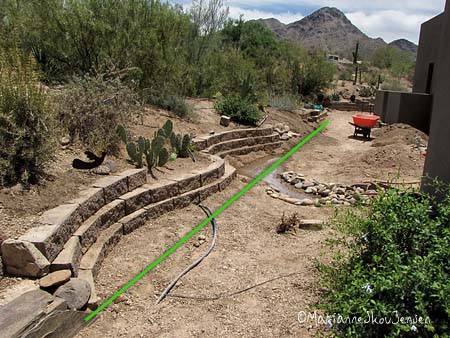
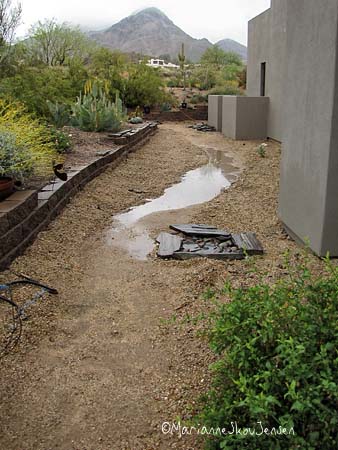
Because I insist on doing all the work myself, progress on this property is slow but there is progress! In this first photo, the green line indicates where the wall was before I started. I relocated a few plants and moved the wall farther back giving a little more room for a path. More interesting, don’t you think? I’m also adding a water retention area to take care of a little flooding that happens a few times a year (see below).
If you can't fight it, make it into a decorative pond 🙂
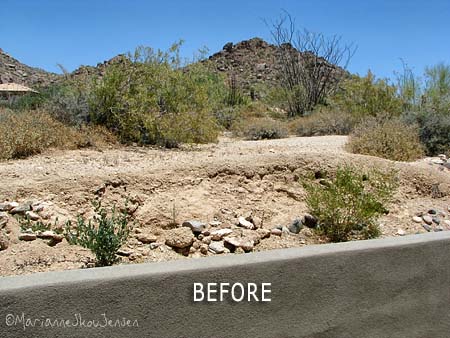
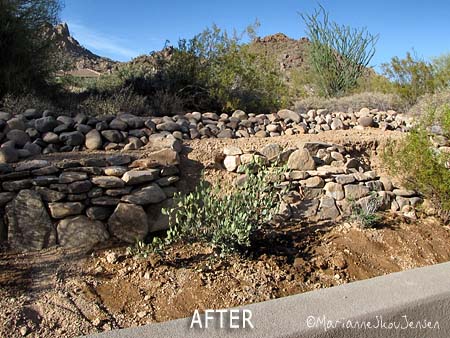
Next shows progress on a problem area where the bank was cut away at a very steep angle.
The ground is mostly caliche so nothing will grow. Rocks seemed the best solution.
In case you don’t already know, I love this stuff. I just don’t remember it being so brutal on my body 🙂