Sedona for a couple of days; then Flagstaff for a few and finally a few days at the Grand Canyon.
Cleo has been looking forward to this for awhile. Surprisingly, he and Cloe love road trips as much as we do!
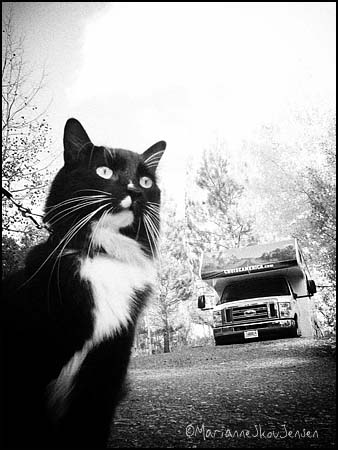
Sedona for a couple of days; then Flagstaff for a few and finally a few days at the Grand Canyon.
Cleo has been looking forward to this for awhile. Surprisingly, he and Cloe love road trips as much as we do!
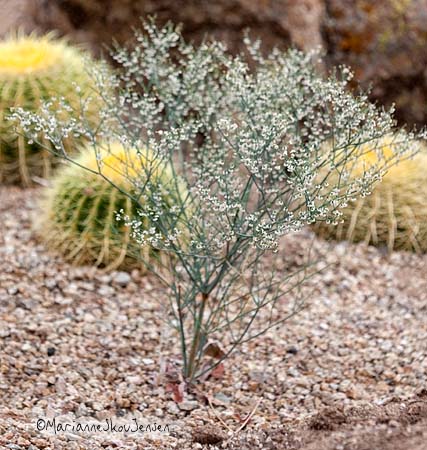
Skeleton Weed (Eriogonum deflexum) is a wild buckwheat that I’m sure most people consider an unattractive nuisance weed. There are no leaves on the stems (hence nickname) but when they finally bloom, I think they’re gorgeous. Of course, I think everything that comes up on its own in my yard is beautiful 🙂
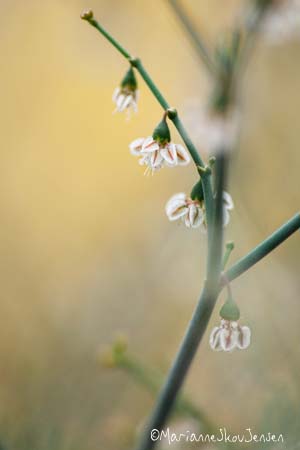
Close-up
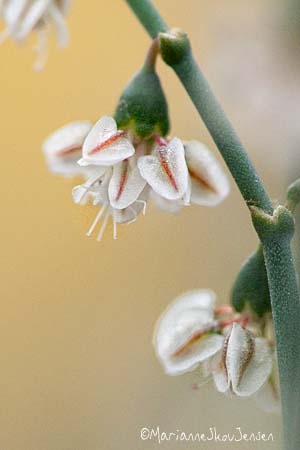
Full plant view.
No photo today. Instead, here’s an introduction to the very cool Manakin Bird.
I read about it yesterday when I saw a clip showing the courtship behavior of of one. Very funny 😀
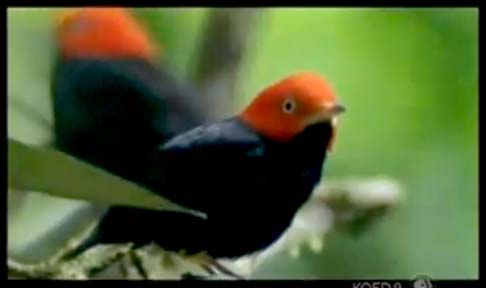
Thanks to Myrmecos Blog for bringing attention to it.
If you enjoy macro photography and seeing insects VERY close-up, be sure to check out his blog.
What do you get when you fool with Mother Nature? A pattern that would look great as a silk scarf!

I started with a shot of blooming Sage.
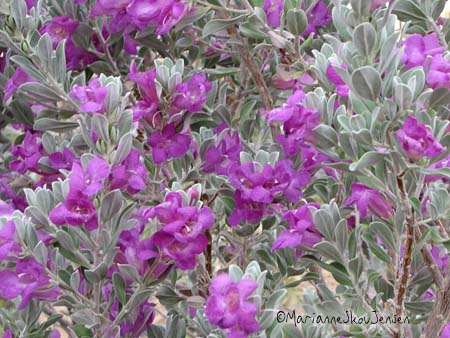
The sky was heavily overcast so of course I couldn’t resist swinging my camera around 🙂
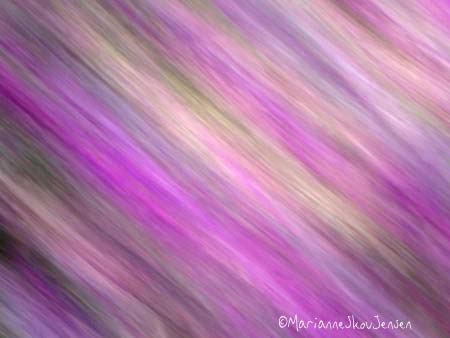
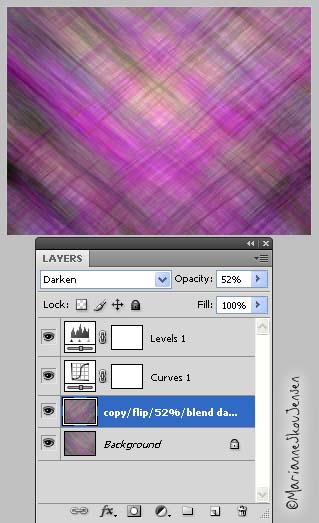
I began rotating it in Photoshop to find the best view which gave me the idea of blending two versions.
So I created a copy layer; flipped it horizontally, lowered the opacity and used the blend mode “darken”.
As a last step, I tweaked color and contrast using Levels and Curves.
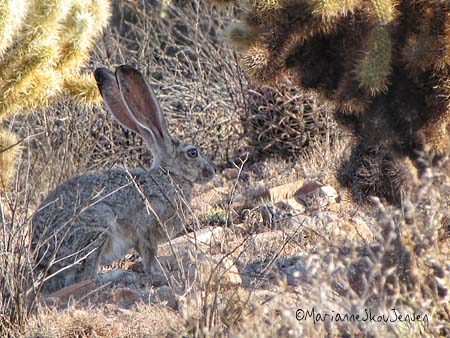
The Hare of the Lost Dog (Wash Trail, that is) is a BIG guy! I’ve seen him before but he was always crossing the trail at an incredible speed. This time a hiker noticed him sitting so it was a treat to get a better look. He was quite a distance away but not too far for my trusty Canon SX10 🙂
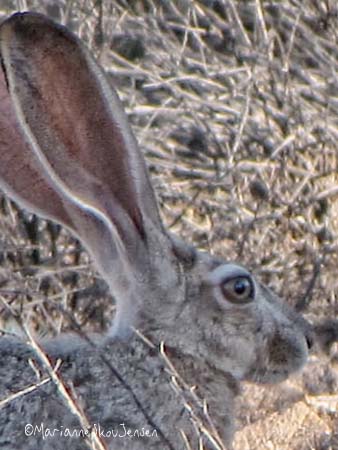
A Hare is different from its rabbit cousins. Their ears are much longer and their heads more elongated. One of the main differences is that the Hare nests above ground in a shallow depression while all rabbits nest under ground. For more differences and photos, click here.
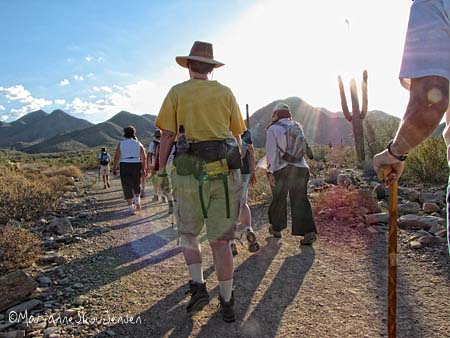
Finally, here are a couple shots from our McDowell Sonoran Conservancy hike this morning. Specifically, we hiked the Ringtail loop off the Lost Dog Wash Trail. It was the last guided hike of the summer so I shot the first image into the sun with the iintention of showing how hot it’s getting here!
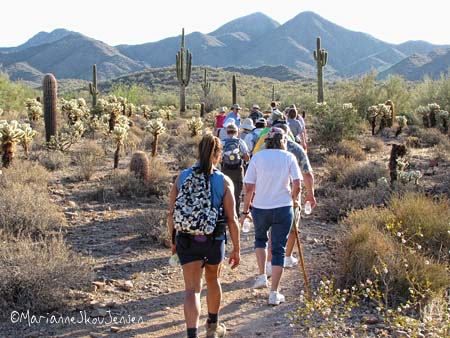
Check the hiking schedule for the fall and come check out all the new trails!
This poor cactus has suffered many nips and bites from Javelina. Being non-native, the Javs loved it but it’s now protected in the fenced area and one of those nips caused a heart to form. It and I are now happy 🙂
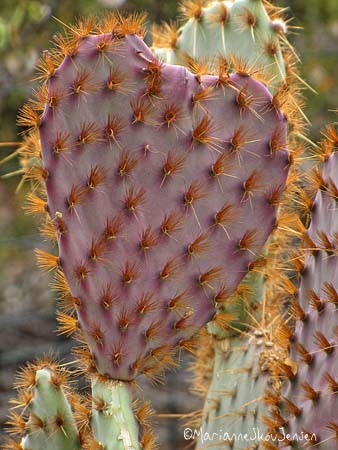
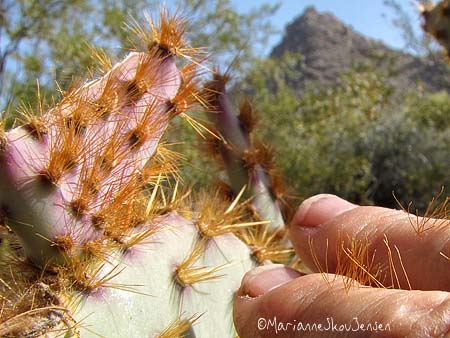
You might remember this cactus from a post last month about glochids.
Here’s that photo again. Note the chomped off pad in the upper left of the photo.
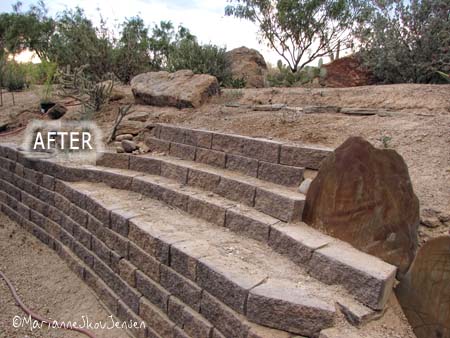
When I finished laying all the blocks in front of this berm a couple of years ago, I didn’t like it. I couldn’t quite put my finger on the reason, though, until after the design portion of Landscaping School. Then it became clear that although the wall served its purpose for erosion control, it wasn’t very interesting.
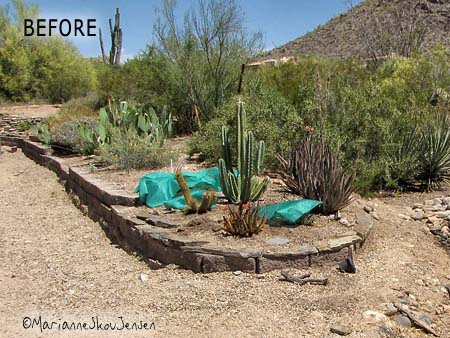
I can’t believe I’m moving these blocks again but I know it’ll be worth all the temporary aches!
(By the way, the fence was added a few months ago to discourage Javelina).
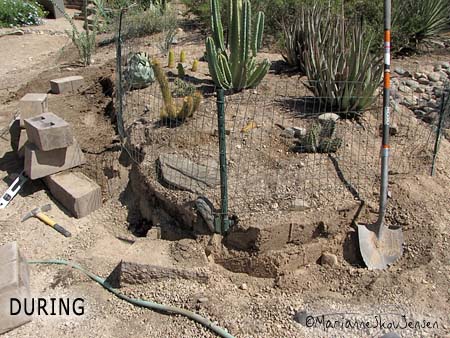
As with the first section of this retaining wall (see June 12th post), I decided to extend it out and terrace it. I added a few drip irrigation emitters in the lower portion. I don’t know what I’ll plant yet but I’ll be referring to my “Javelina resistant” plant list 🙂
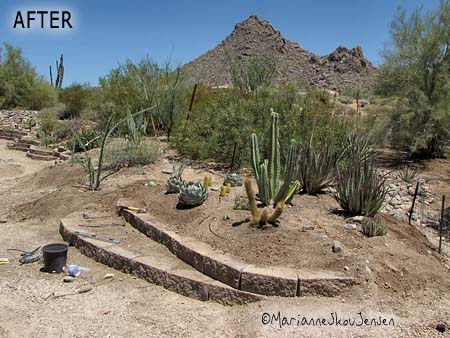
As with “Javelina Cafe”, this area has been a favorite of the local Javelina but as the plants are getting established, it’s harder for them to push them over to get to the roots so I’m hoping I don’t need the fence anymore.
The cardinal rule for landscapers is to locate all underground utilities and water lines before digging. What I need is a bunny nest detector! Here are a couple of shots from last week of two baby Desert Cottontails. It just occurred to me this morning why I happened to see them when I did. When I was digging irrigation holes for another tree, I inadvertently disturbed a rabbit nest 🙁
When I finished the 5th hole and turned around, I saw one little bunny hopping under the bush above the hole. Unbelievably cute! My camera was close by and when I looked through the viewfinder, I could see there were two. As I was going back and forth between the house and the tree, I would notice the mother and after about a half hour, they were all gone. I sure hope they make it as I don’t think they were quite ready to be on their own.
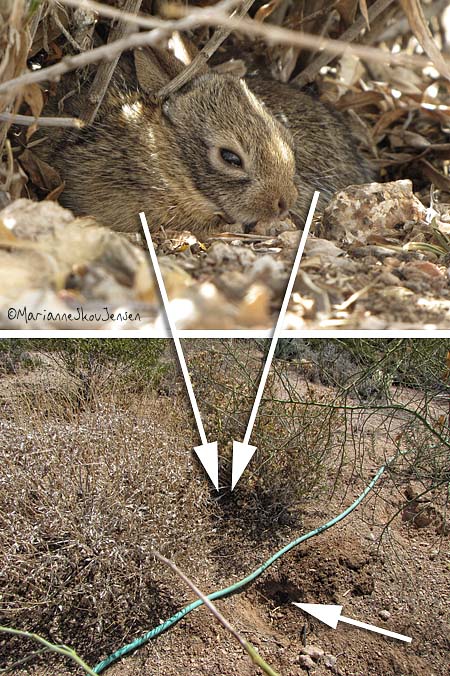
Yesterday morning, I noticed a Desert Cottontail digging a hole in the front courtyard between two Lantana. Each time I passed the hole, I told myself : “get a documentary photo!”. I can see it from my kitchen window so I could have taken a shot with her by the hole but I was really busy yesterday and by the time I finally got the camera, she had covered the hole.
This is the 3rd time I’ve see a hole dug and then covered so I became really curious. After much googling, I could not find any mention of holes being covered back up with dirt. But…I did read that that they cover their nests for protection and when I wrote asking a friend (thanks Steve), he said he read that they “plugged” their nests.
So….after learning how they feed their babies, I’m guessing the dirt serves to cover their scent and thus protect them from predators. How do they feed their babies? This is so cool! She simply lays across the hole and the babies come up and suckle. I’m betting they’re born with an instinct to dig and they go through the dirt to get to her.
(Stay tuned. I’m going to try some time lapse photography to see if I can catch her sitting on the nest!)
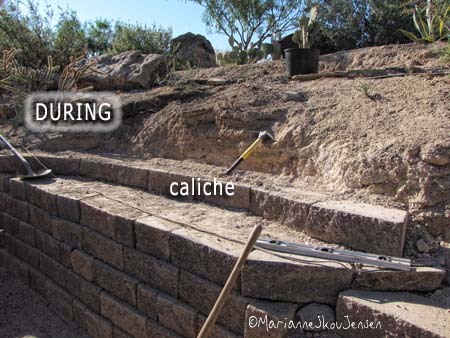
Another landscaping progress report. Lifting these blocks has been tough hard but not as hard as chipping through caliche on this berm! Singing chain gang songs while working helped 🙂
Before: a boring wall
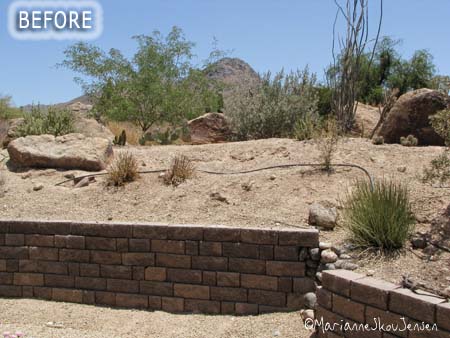
Chip, chip, chip!
After: So much better! How do you like my metal boulders? They’re a work in progress.
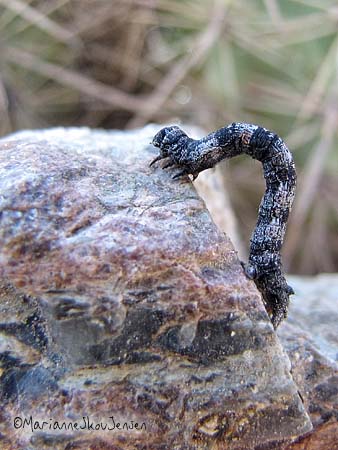
There are lots of positives about posting a photo a day (almost) but the biggest plus for me is that I quite often end up learning something. Take this inch worm, for instance. As many times as I’ve seen and enjoyed watching them, I never knew what they were. With the help of Google, I now know they are of the family Geometridae or Geometer moth. One of their funny behaviors I especially enjoy seeing is when they mimic a stick. I thought it was a defense move but Wikipedia says this is their resting position. I also found out that their nickname comes not from their size but their measuring-like motion way of traveling.
I couldn’t find an image of what he’s going to turn into but I’m sure it’s one of the moths that I’ve photographed under the outside sconce lights. If you’re curious about inchworms, click on the photo to go to Wikipedia.